GeoHistory Journey
Imperial China
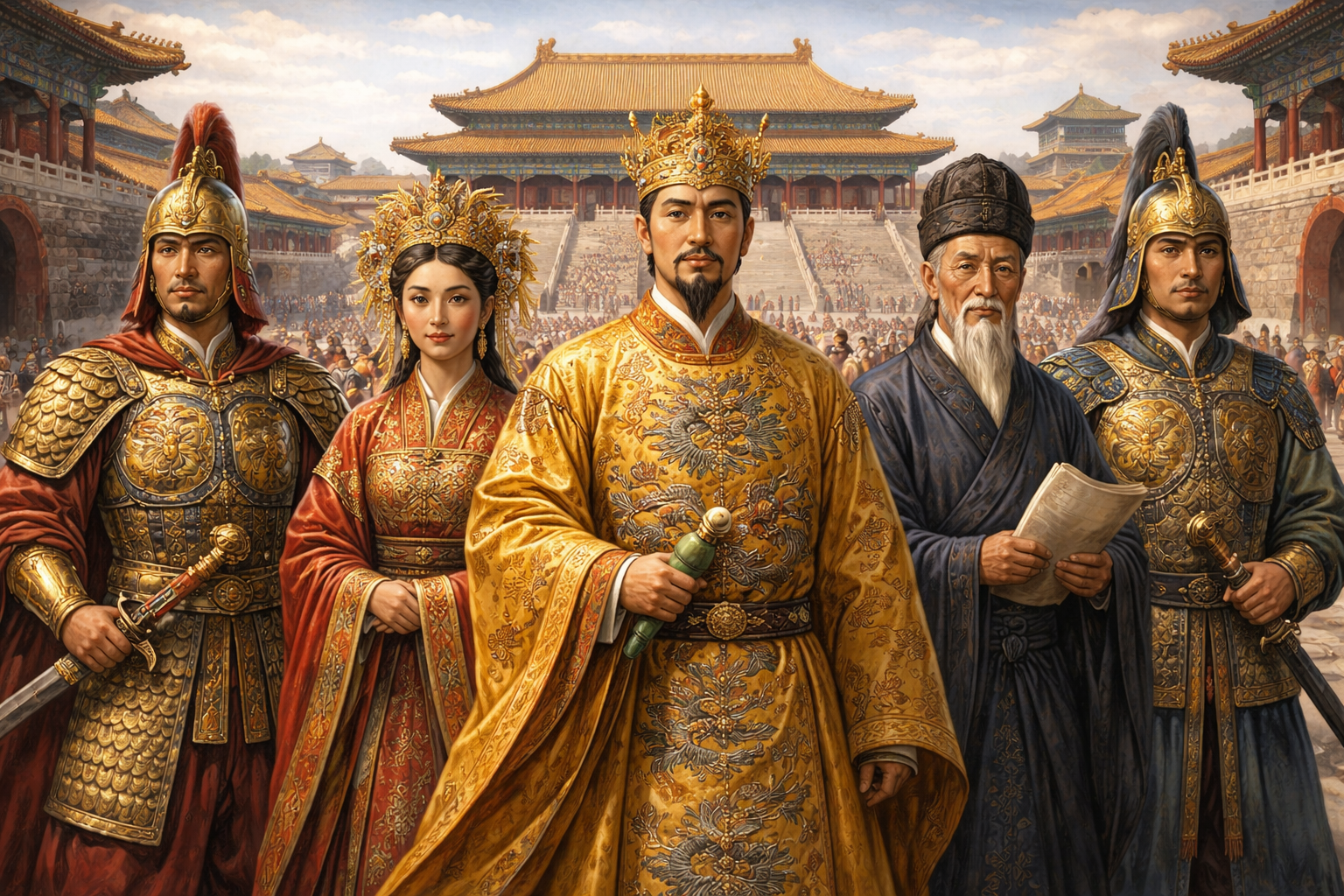
In 221 BCE, in North China, Qin unification imposed unprecedented Legalist centralization. In the 2nd–1st centuries BCE, at Chang’an, the Han under Emperor Wu turned that framework into an expansive, Confucian-tinged state. In 9 CE, at Chang’an, Wang Mang’s radical reforms collapsed into crisis and Eastern Han restoration at Luoyang in 25 CE. In 184 CE, across the Central Plain, the Yellow Turban uprising triggered the end of Han order. Between 280 and 316 CE, at Luoyang, brief Western Jin reunification gave way to invasions and large southward migrations. From 317 to 589, between Jiankang and the northern plains, Northern and Southern dynasties fostered sinicization and cultural fusion. From 581 to 618, at Luoyang, the Sui reunited the realm, dug the Grand Canal, and initiated examinations. From 618 to 755, Chang’an was the cosmopolitan heart of Tang, before the An Lushan Rebellion (755–763) shattered that balance. Between 763 and 907, jiedushi power hastened Tang collapse, followed by the Five Dynasties and Ten Kingdoms (907–960). From 960 to 1127, Kaifeng led the Northern Song economic revolution under pressure from Liao and then Jurchen Jin (916–1234). Between 1127 and 1279, Lin’an (Hangzhou) sustained the Southern Song with military and commercial innovation until the Mongol conquest (1206–1279). From 1271 to 1368, at Dadu, the Yuan ruled a multiethnic empire, followed by the Ming restoration (1368–1424) at Nanjing and Zheng He’s voyages (1405–1433). Between 1449 and 1550, the Tumu Crisis pushed the Ming toward wall-based defense, while from 1557 Macao opened Euro-Chinese exchange. From 1628 to 1683, Ming collapse and Manchu conquest laid the ground for the Qing zenith (1683–1796), before the Canton System (1757–1842), rebellions (1796–1804), and Opium and civil wars (1839–1864) cracked the order. Between 1861 and 1912, across Beijing, Shanghai, and Guangzhou, technical reforms, external defeats, and revolutions culminated in the New Policies and Xinhai, closing the imperial era.
This Journey requires a free account to open the interactive experience.