GeoHistory Journey
China's Rebirth: From Empire to Global Power
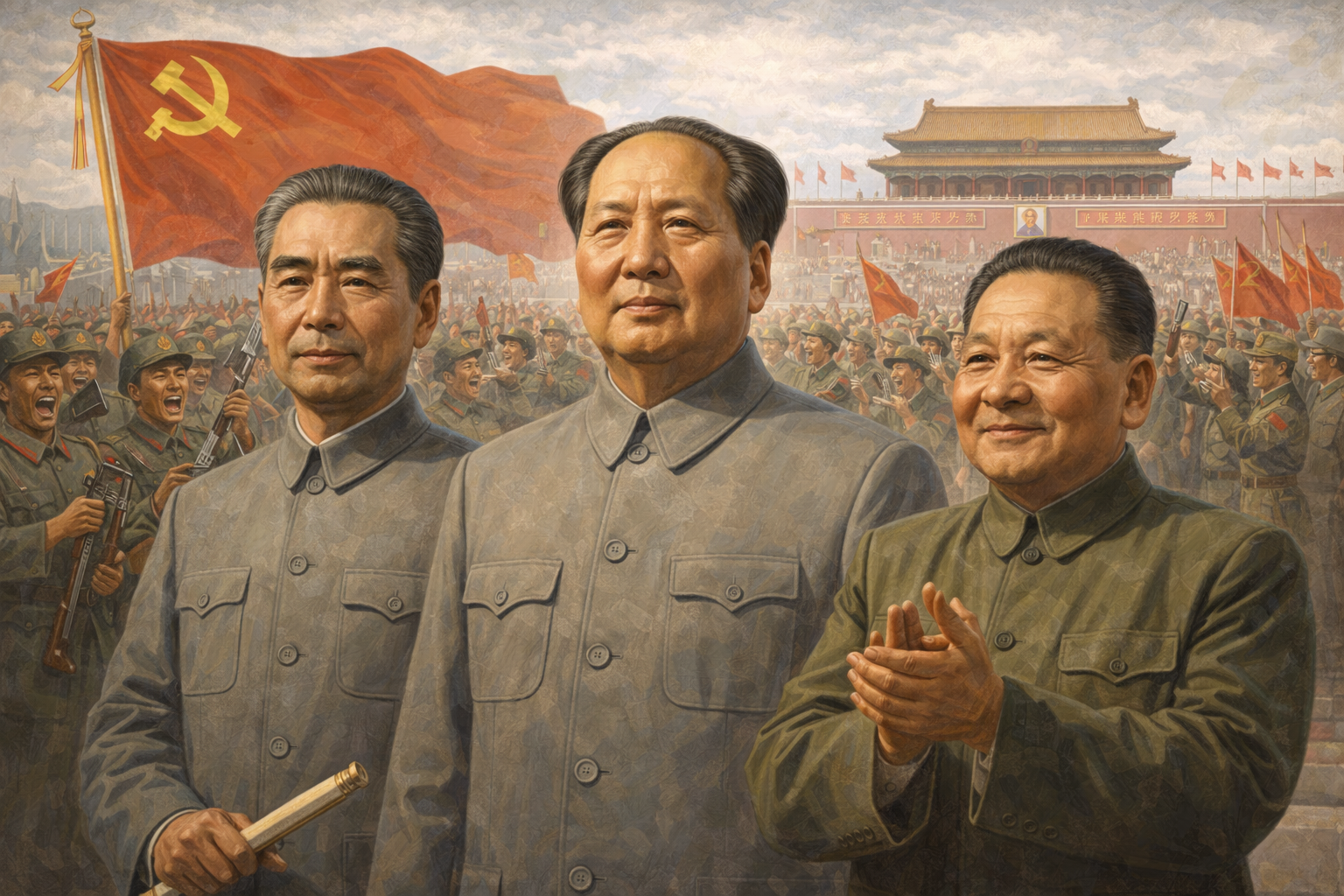
Between 1912 and 1949, China moved from a fallen empire to a fractured republic, marking a prolonged institutional transition. In 1916–1928, power splintered among warlords, with Beijing as the political hub and decisive northern campaigns reshaping authority. From 1926 to 1928, the Northern Expedition partially reunified the country, elevating Nanjing as the Nationalist capital under Chiang Kai-shek. After 1931, Japanese encroachment in Manchuria opened an external front that culminated in the 1937–1945 Second Sino-Japanese War, with a wartime capital in Chongqing. In 1945–1949, the renewed civil war ended with Communist victory and, in 1949, the founding of the People’s Republic in Beijing. In 1950–1957, the priority was heavy industrialization with Soviet assistance, while the 1958–1962 Great Leap Forward triggered a nationwide crisis. Between 1966 and 1976, the Cultural Revolution harshly reshaped society and institutions, even as China re-entered global diplomacy with the UN seat (1971) and Nixon’s visit (1972). From 1978, the Third Plenum launched reform and opening, tested in Special Economic Zones, especially Shenzhen. In 1989, mass protests in Beijing led to a recalibration of reforms; in 1992, the Southern Tour reignited market-driven growth. In 1997, Hong Kong’s return created a vital financial bridge between China and the world. In 2001, WTO accession integrated China into global trade rules, paving the way for a manufacturing boom. In 2008, the Olympics provided a global showcase of modernization and organizational capacity. In the 2010s, China advanced infrastructure and technology with the Belt and Road announcement (2013), Made in China 2025, and the founding of the AIIB (2015–2016). In 2022, completion of the Tiangong space station and the 20th CCP Congress signaled scientific ambition and political consolidation. Over a century, actors such as the KMT, the CCP, external powers, and regional capital reshaped Asia, with global consequences in trade, security, and innovation.
This Journey requires a free account to open the interactive experience.