GeoHistory Journey
The Russian Revolution and Communism
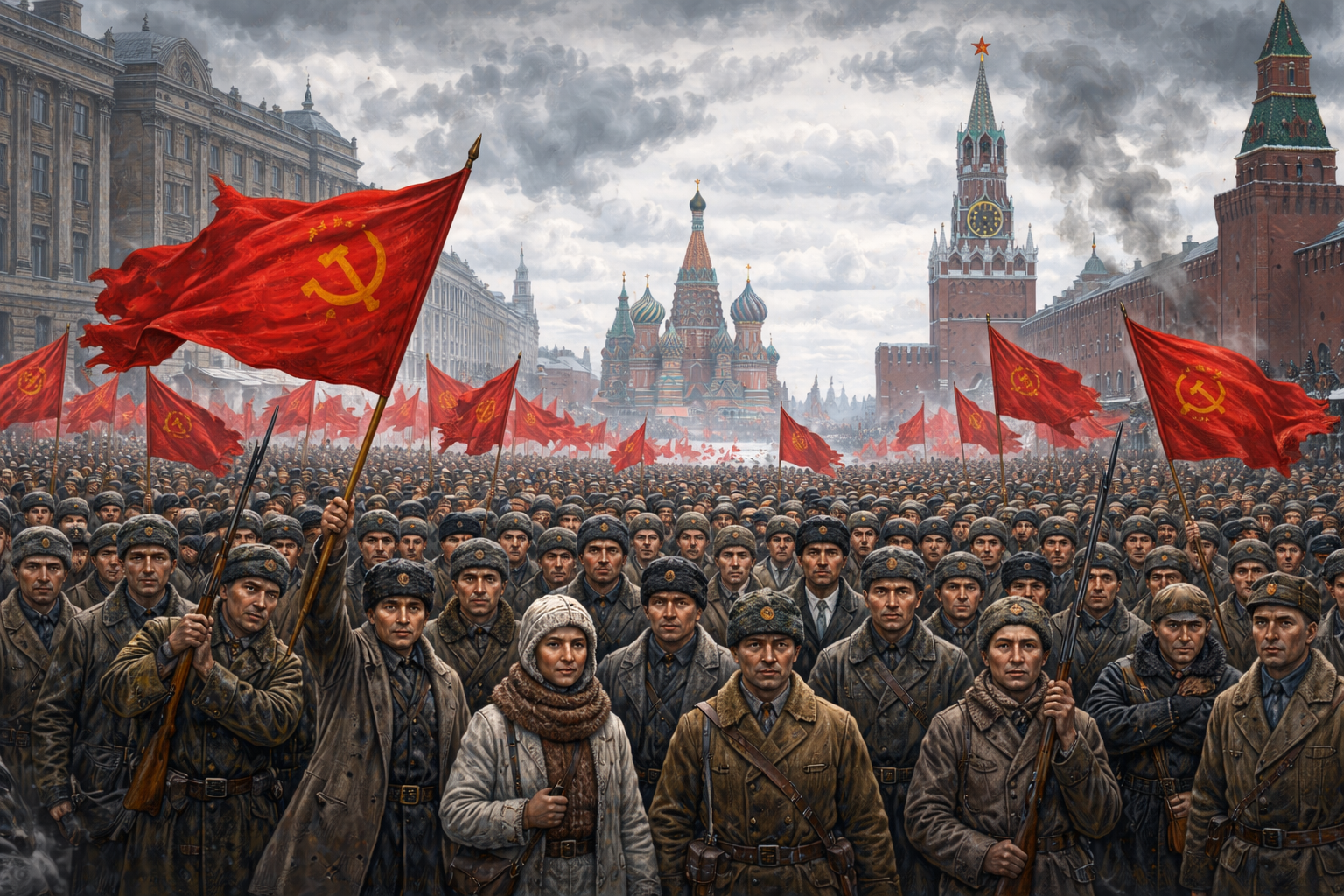
This journey spans Eastern Europe and Eurasia from 1861 to 1991, tracing the arc from the Tsarist Empire to the USSR and its collapse. The actors include emancipated yet indebted peasants, factory workers, a declining nobility, socialist revolutionaries, peripheral nationalities folded into a Soviet state, and the peoples of satellite countries. Politically, it moves from autocracy through the 1917 revolutions to one-party dictatorship and a Cold War ideological empire; economically, from rapid industrialization and the NEP to centrally planned Five-Year Plans, amid famine and giant industrial projects; socially, it features forced mobility, repression, and mass literacy; religiously, it sees the sidelining of Orthodoxy and militant secularization. Key innovations include transcontinental railways, electrification, planned economic management, mass propaganda, and new modes of political mobilization. Diplomacy and trade swing between rupture and accommodation: from Brest-Litovsk to the Molotov–Ribbentrop Pact, from Yalta to controlled exchanges with the West; Not available for granular details of trade in each phase. Wars and crises punctuate the path: World War I, civil war, purges, famines, the Battle of Stalingrad, uprisings in Eastern Europe, and the system’s final implosion. The legacy is twofold: a vast experiment in authoritarian modernization and an ideology that reshaped the twentieth century, leaving contested memories of emancipation, violence, and collective ambition.
This Journey requires a free account to open the interactive experience.