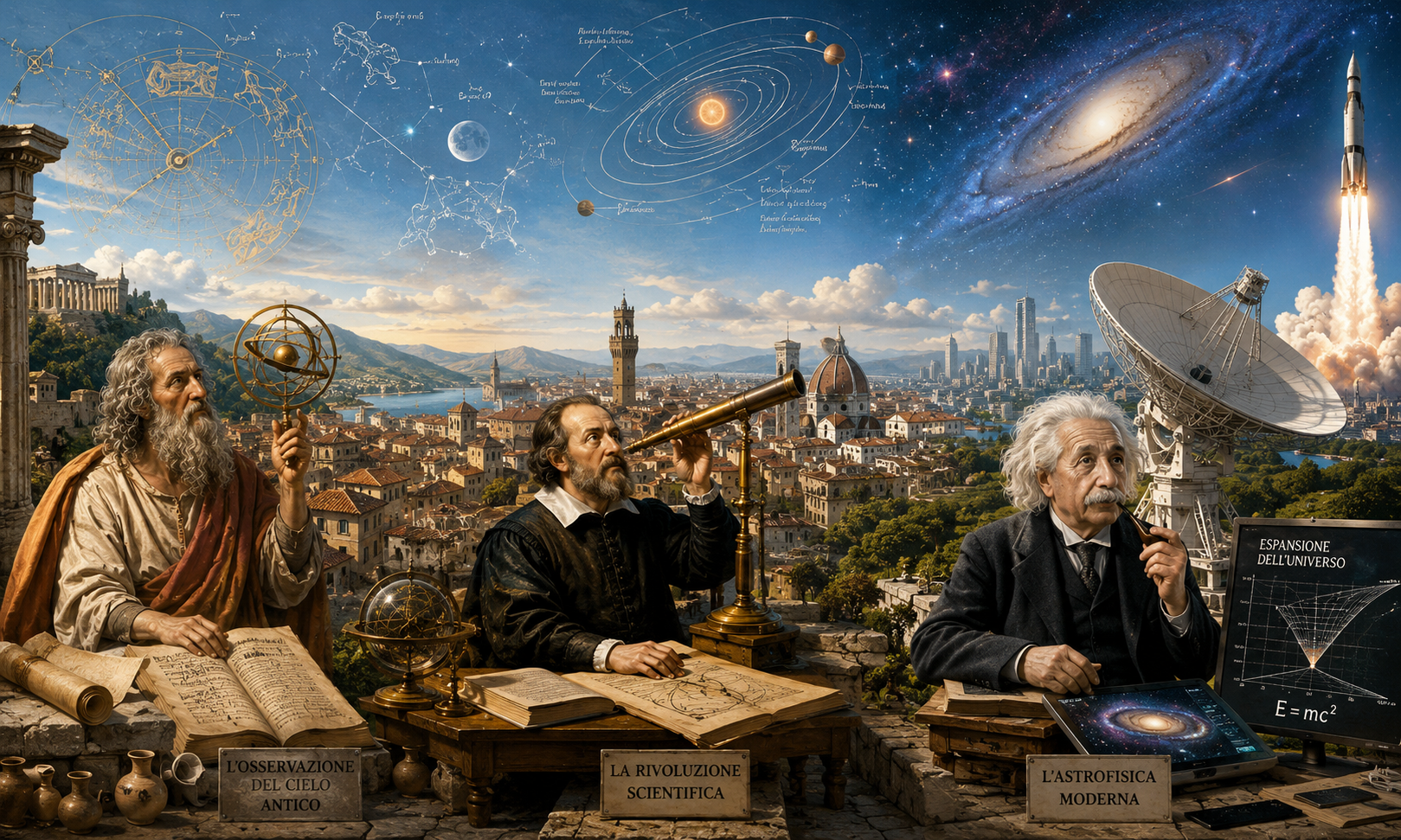
The History of Astrophysics
Astrophysics emerged when the sky ceased to be merely a clockwork of spheres and became a natural laboratory. From ancient geometries seeking order in motions, the field broadened through instruments, measurements, and ideas that revealed what stars are, how they live, and why the Universe expands. Every breakthrough joins method and technology: precise Greek catalogs, modern calculations, prisms splitting light, telescopes extending sight, radio dishes listening to the sky, and detectors tracing gravitational waves. This story spans centuries and continents: from Hipparchus’s precession and Ptolemy’s synthesis to the Copernican turn and Galileo’s telescope; from Kepler’s laws to Newton’s gravity; from spectroscopy to stellar elements, then twentieth-century cosmology with relativity, distant galaxies, the cosmic microwave background, dark matter and dark energy. In the end, exoplanets, high-precision cosmic maps, gravitational waves, and a black hole’s shadow reveal a multi-messenger astrophysics, weaving light, particles, gravity, and computation to read the fabric of the Universe.