GeoHistory Journey
The History of the Internet: From Electrical Networks to the Global Web
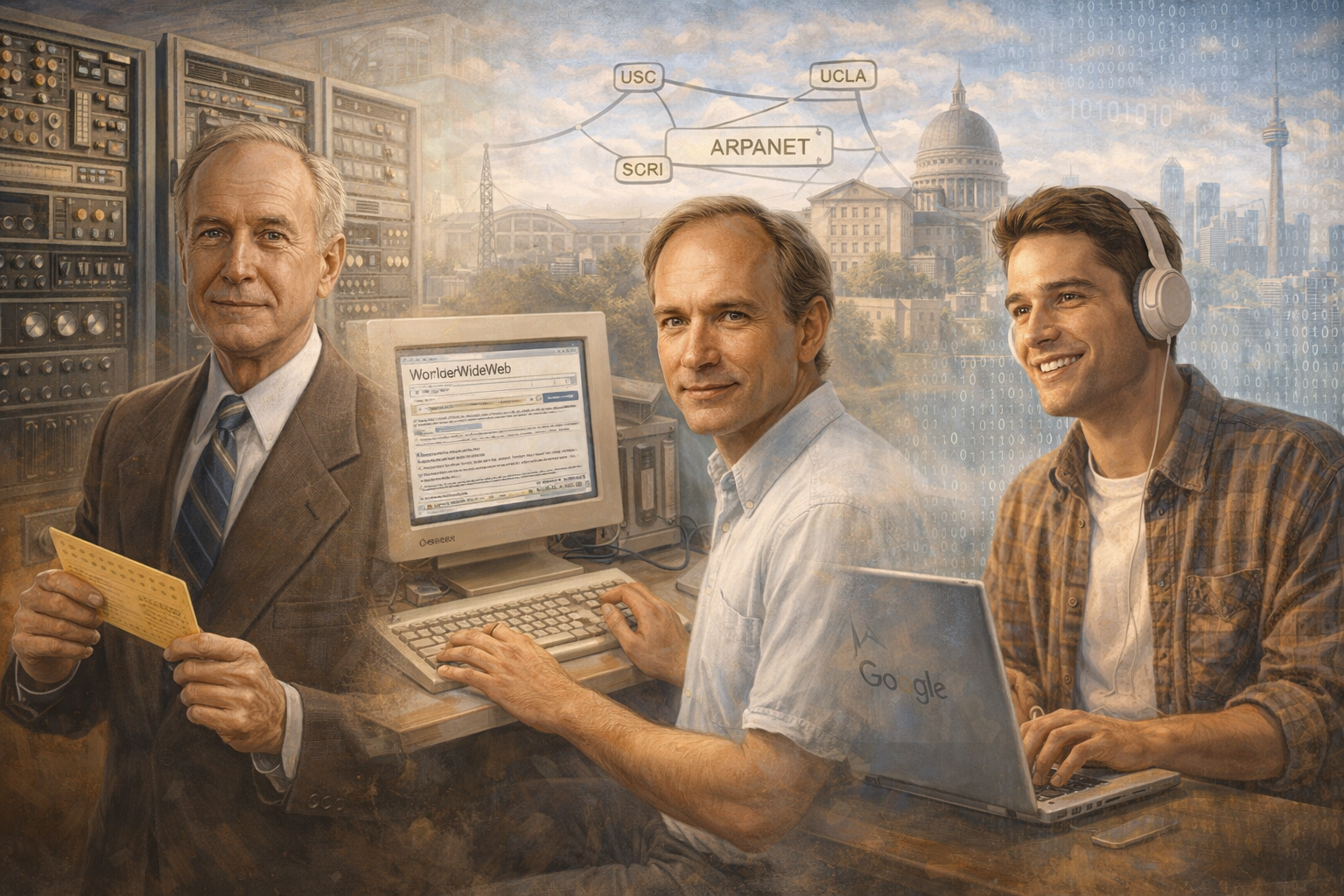
Starting in 1837 in Europe, telegraph wires and needles accelerate information along railways. In 1844 in North America, Morse’s message between Washington and Baltimore institutionalizes long-distance communication. In 1866, between Ireland and North America, the transatlantic cable tightens global economic and political links. In 1876 in Boston, Bell’s voice inaugurates real-time audio, a precursor to digital data services. In 1901 at Poldhu, Marconi’s wireless signal opens the global dimension of the ether. After World War II in Washington, Vannevar Bush envisions hypertext trails that inspire online knowledge architecture. With ARPA in 1958, the United States invests in shared computing and networking, launching a long research trajectory. In the early 1960s, between Cambridge and London, packet switching by Kleinrock and Davies defines the unit of digital information transport. In 1969 in Los Angeles, ARPANET connects its first nodes, and by 1971 email emerges as a social practice. Between 1973 and 1977, from Stanford to Menlo Park, TCP/IP achieves interoperability across heterogeneous networks. In the 1980s, from Ann Arbor to Marina del Rey, NSFNET and DNS scale infrastructure and addressing. Between 1989 and 1993, at Meyrin and Urbana-Champaign, the Web and popular browsers bring hypertext to the masses. From 1995 onward, across Los Angeles, Brussels, and the world, governance (ICANN), rules (net neutrality, GDPR), and shocks (Morris worm, Snowden, COVID-19) shape the Internet’s uses, rights, and resilience. Key implication: the convergence of open standards, public investment, and social demand made the Internet a global platform, continuously negotiated among technology, markets, and rights.
This Journey requires a free account to open the interactive experience.