GeoHistory Journey
Mesopotamian Civilizations
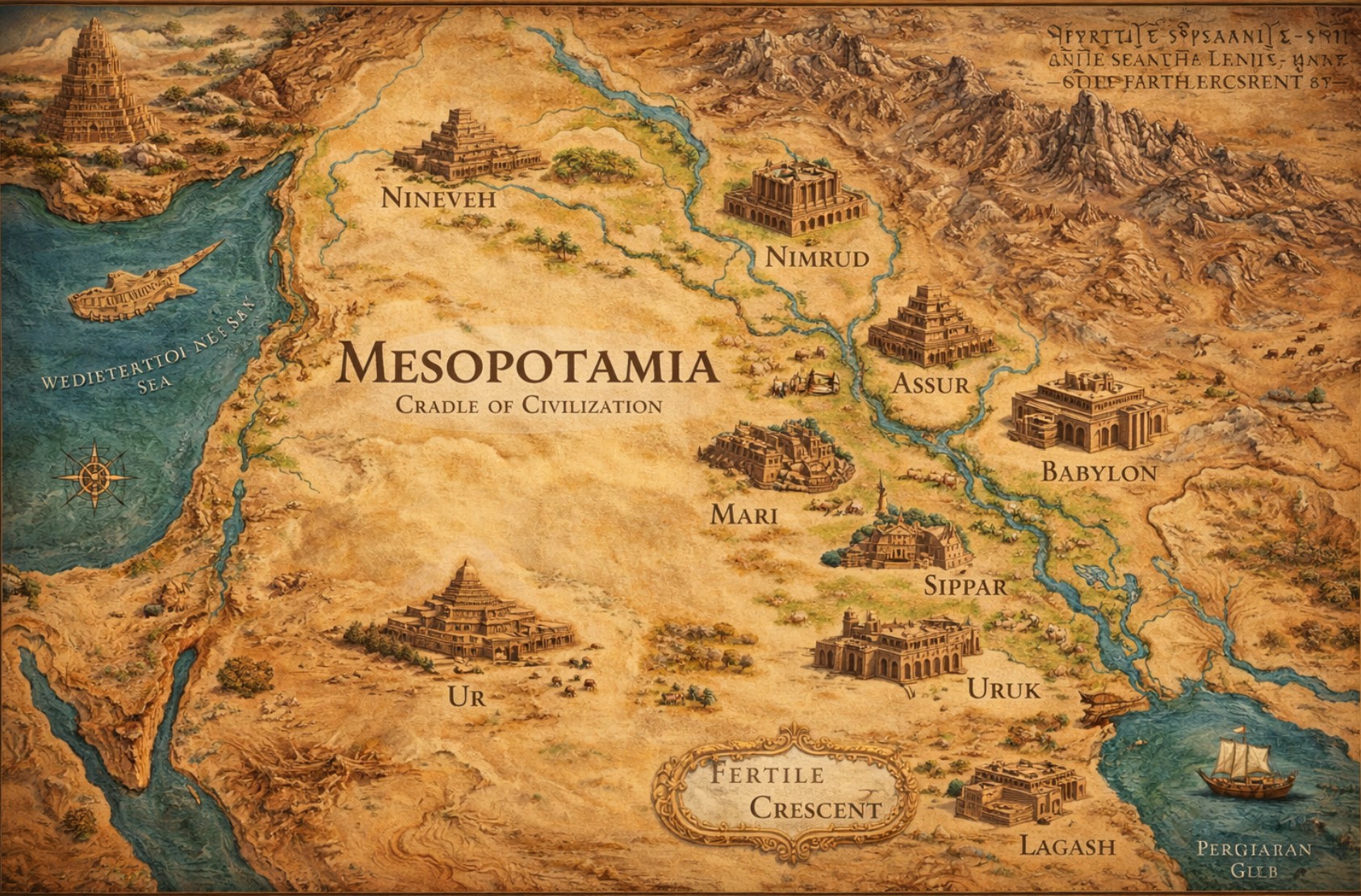
Between the Tigris and Euphrates, the story begins with water mastered and communities anchored in mud and reeds—from Ubaid-era settlements at Eridu to the explosive urban pull of Uruk. Cuneiform appears inside temple and warehouse routines, turning memory into administration, while Jemdet Nasr sharpens the tools of control. In Early Dynastic Sumer, city-states compete for canals, fields, and legitimacy, and the Lagash–Umma struggle shows how borders could be fought over as fiercely as harvests. Urukagina’s reforms reveal social pressure behind the façades of power. Sargon converts local rivalry into empire, and under Naram-Sin imperial authority becomes an ideology—before crisis, fragmentation, and invasions unravel the system. Ur III rebuilds order through dense bureaucracy and gives law a central role with the Code of Ur-Nammu. After Ur falls, Babylon rises under Hammurabi and his famous codification, only to face new shocks: the Hittite sack and the long, stabilizing Kassite era. Neo-Assyria then militarizes the region on an imperial scale until Nineveh collapses, allowing a Neo-Babylonian return to monumental grandeur. The journey closes with Cyrus: Babylon enters the Persian world, and Mesopotamia becomes a key node inside a far larger empire.
This Journey requires a free account to open the interactive experience.