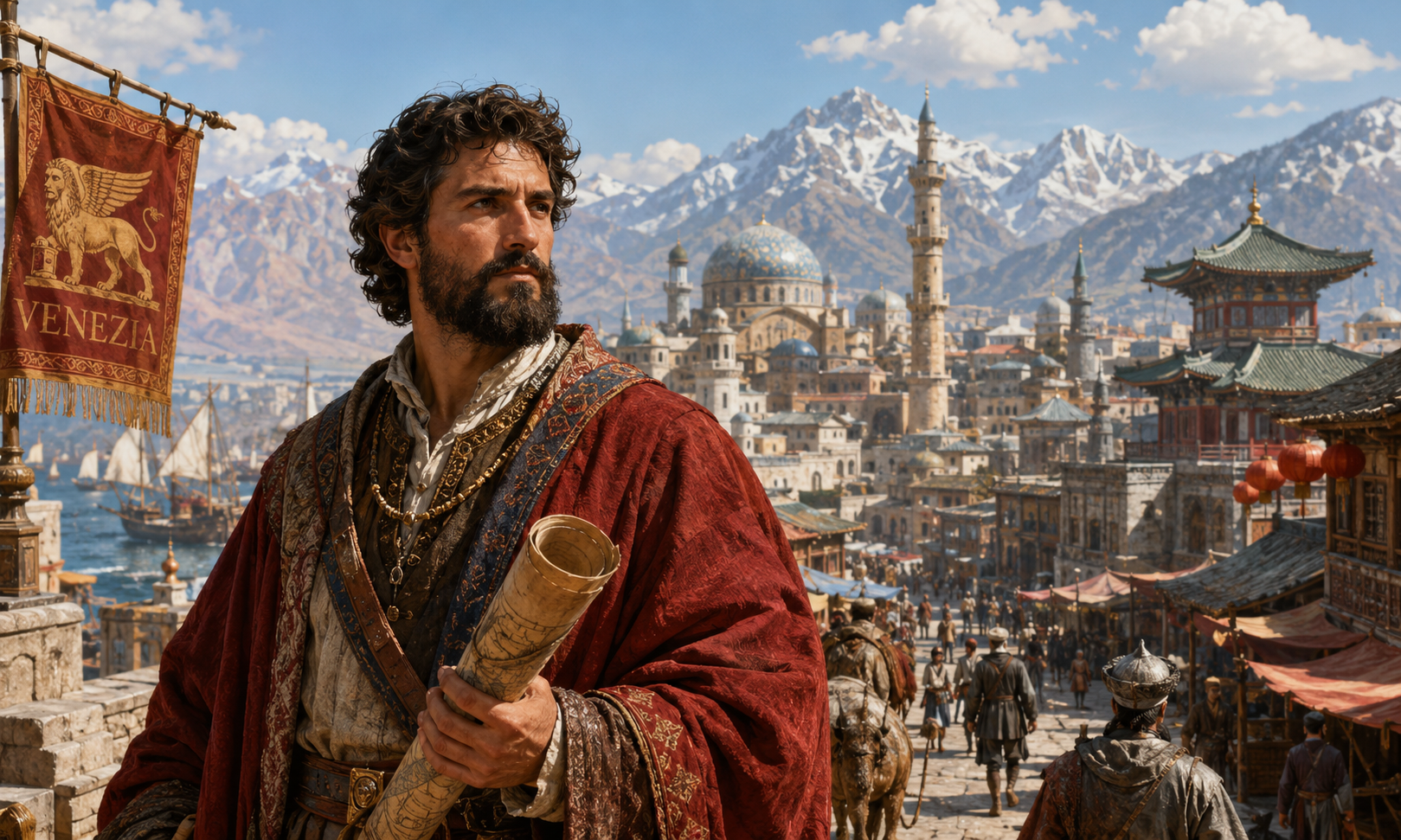
Marco Polo
In the thirteenth century, Venice was a maritime power looking beyond the Adriatic to distant ports, caravanserais, and courts. Its ships stitched the Mediterranean to the Black Sea, while merchants and brokers held together different tongues and currencies. Within this web of exchange, the Polo family turned mercantile curiosity into diplomatic mission, taking advantage of the relative safety of Eurasian routes under Mongol rule. Their journey was anything but linear: it followed winds and seasons, climbed air-thin plateaus, and threaded through resurgent cities to the court of Kublai Khan, where Latin Europe met an empire that issued paper money and governed through a lattice of postal stations. Years of service, political assignments, and provincial inspections made Marco an insider witness to a world in motion, and on the return—through monsoons and crowded anchorages—he carried back to Venice goods, stories, and administrative know-how that fed both imagination and trade. Genoese captivity turned memories and notes into a book, The Travels, which fixed on the page a shared horizon between the Mediterranean and Asia. His life reads as a thread linking Armenian havens, Uyghur oases, Chinese metropolises, Indian coasts, and Persian courts: a path where commerce, diplomacy, and writing bridged worlds.