GeoHistory Journey
The Renaissance
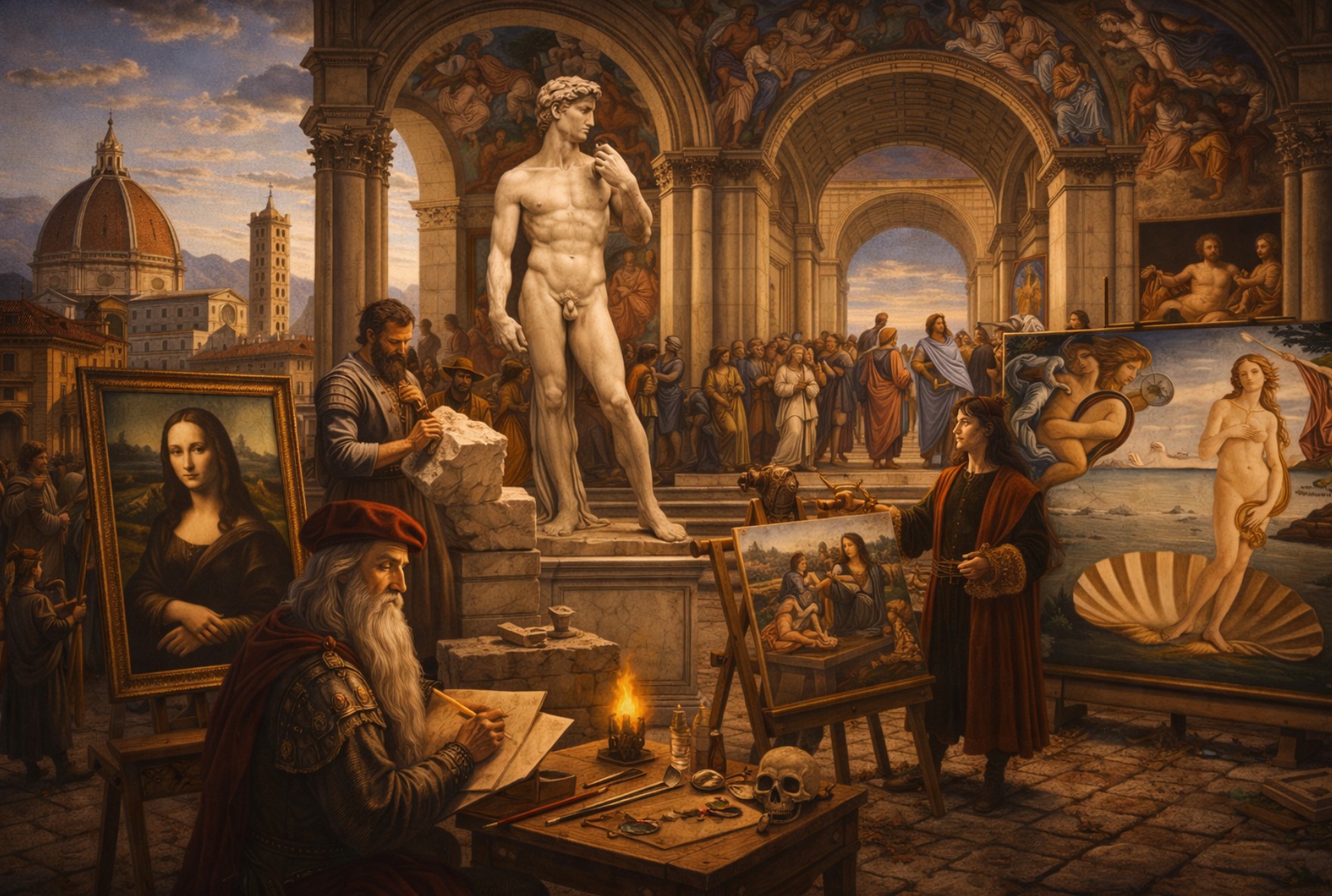
The Renaissance begins as a public revival of humanism and classical prestige, signaled early by Petrarch’s laurel crown in Rome. In Florence, the long construction of Santa Maria del Fiore becomes a civic laboratory where ambition is measured in stone, culminating in Brunelleschi’s daring dome and its completion. Art turns competitive and systematic—from the Baptistery door contest to workshops that make innovation a shared visual language. Rome institutionalizes learning through the Vatican Library, while the fall of Constantinople channels Greek texts and expertise into Italian study and translation. Gutenberg’s Bible shows how print can multiply ideas, reshaping Europe into a continent where books, arguments, and discoveries travel with unprecedented speed. Political stability remains fragile: the Pazzi Conspiracy exposes the violent edge of Florentine power even at the height of Medici splendor. Artists bring antiquity into the present—Botticelli and Leonardo refine narrative and emotion—while Michelangelo’s Sistine ceiling pushes ambition to monumental scale. The world’s horizon expands with Columbus and the Age of Exploration, even as Europe fractures with Luther’s theses and the rise of religious reform. The Sack of Rome marks a deep shock that shifts cultural centers without extinguishing creative energy. From Copernicus to Galileo, scientific methods gather force, and with the Council of Trent the Catholic response reorganizes doctrine and society—an ending that opens directly onto modernity.
This Journey requires a free account to open the interactive experience.